
Technology titans often clash. Elon Musk, CEO of SpaceX, and Jeff Bezos, founder of Blue Origin, have publicly criticized each other in the space race. Bill Gates and Steve Jobs once argued over whether Microsoft’s products had copied ideas from Apple.
In today’s biggest technology revolution, generative AI, Reuters says the rivalry between Sam Altman, CEO of OpenAI, and Dario Amodei, CEO of Anthropic, is also becoming a major force behind both companies. Their competition is accelerating the release of AI tools, new features, and even shaping the way people interact with technology in everyday life.
“It is an all-out war. Every time Anthropic launches a new product, people bet that OpenAI will respond soon, and vice versa,” said Anastasios Angelopoulos, CEO of Arena, a company that evaluates and audits artificial intelligence systems.

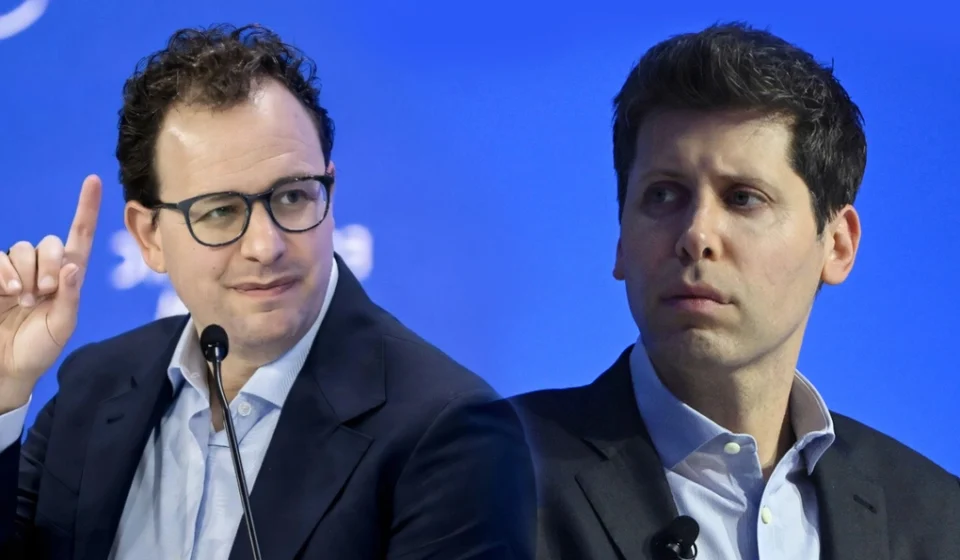
Anthropic CEO Dario Amodei (left) and OpenAI CEO Sam Altman. Photo: TechXplore/CNN
Anthropic CEO Dario Amodei (left) and OpenAI CEO Sam Altman. Photo: TechXplore/CNN
OpenAI was founded in 2015 by a group that included Sam Altman, then president of YC Group; SpaceX CEO Elon Musk; LinkedIn co-founder Reid Hoffman; and several others. At first, it was a nonprofit organization focused on artificial intelligence research, with a pledge to advance the technology for the benefit of humanity. In mid-2016, impressed by OpenAI’s pool of talent, Dario Amodei decided to join the organization and work on AI models.
However, tensions began in late 2020, when Amodei left his role as OpenAI’s vice president of research along with several others to establish Anthropic. According to WSJ, they felt their former company had become “too focused on commercialization” and were concerned about safety issues as well as Altman’s leadership style.
In early 2022, Anthropic trained the first version of its Claude chatbot but delayed a broad rollout to conduct more research on safety. Reuters, citing people familiar with the matter, said OpenAI was also working on similar projects at the time.
OpenAI had once considered releasing a conversational virtual assistant in March 2023 alongside the large language model GPT-4. But rumors about Anthropic’s project in mid-November 2022 pushed Altman to act more aggressively. He instructed employees to develop a chatbot as quickly as possible. “Suddenly, we had to launch a product within two weeks,” one employee told Reuters.
That product was ChatGPT, launched on November 30, 2022. It quickly became the fastest-growing consumer application in history, attracting millions of users and disrupting the product roadmaps of many major technology companies. Anthropic introduced its flagship chatbot Claude a few months later.
Relations between the two companies worsened after Sam Altman was unexpectedly fired by OpenAI’s board of directors in late 2023. During its deliberations, the board briefly spoke with Amodei about the possibility of merging the two companies under his leadership. The idea was quickly dismissed, and Altman was reinstated a few days later.
In late 2024, Amodei urged researchers to shift their focus toward reasoning models after seeing OpenAI’s early success in the field. The situation reversed in late 2025, when Anthropic, which had focused on enterprise customers, released a powerful upgrade to its programming tool Claude Code. OpenAI, whose revenue largely came from paid ChatGPT users, also began increasing its focus on enterprise software and investing more resources in its own coding product, Codex.
Earlier this year, Anthropic used the Super Bowl to mock OpenAI’s idea of introducing ads into ChatGPT. The ad depicted a seemingly helpful conversation suddenly turning into an awkward sales pitch, ending with the statement: “Ads are coming to AI, but not to Claude.” Altman criticized Anthropic’s Super Bowl ad as “deceptive,” saying it distorted OpenAI’s plans.

Sam Altman, CEO of OpenAI (sixth from left), stands next to Dario Amodei, CEO of Anthropic (seventh from left), at the AI Impact Summit 2026 in India, but the two do not hold hands. Photo: Reuters
Sam Altman, CEO of OpenAI (sixth from left), stands next to Dario Amodei, CEO of Anthropic (seventh from left), at the AI Impact Summit 2026 in India, but the two do not hold hands. Photo: Reuters
At the AI Impact Summit 2026, held in India in February, Indian Prime Minister Narendra Modi encouraged technology executives on stage to hold hands and raise them as a gesture of unity. However, Altman and Amodei only raised their fists. The two avoided eye contact, while Bloomberg described the moment as rather awkward. “Once rivals, always rivals,” the outlet commented.
In March, Amodei accused Altman of taking advantage of a dispute between Anthropic and the Pentagon to benefit OpenAI. The conflict arose after Amodei refused to allow the U.S. military to use his company’s AI to conduct mass surveillance of citizens and operate autonomous weapons. While U.S. President Donald Trump ordered all federal agencies to stop using Anthropic products, Sam Altman quickly announced that OpenAI had signed an AI supply contract with the Pentagon. In a letter to employees, Amodei called OpenAI’s media messaging “an outright lie.”
On May 28, Anthropic announced it had raised 65 billion USD, lifting the company’s valuation to 965 billion USD and making it the most valuable AI startup at the time, surpassing OpenAI, which was valued at 852 billion USD in its latest funding round in March.
Data from analytics platform Sensor Tower, released on June 2, showed that the ChatGPT app reached one billion monthly active users in May. Popular Science noted that ChatGPT had grown faster than earlier landmark products such as Google Maps, which took 10 years; TikTok, which took five years; and Instagram, Facebook, and YouTube, each of which took eight years.
Reuters said ChatGPT’s milestone was especially significant because it came as Anthropic and OpenAI were competing fiercely for leadership in the rapidly expanding AI market.
As of the second quarter of 2026, Claude had 56 million monthly active app users worldwide, but it was growing quickly. Sensor Tower noted that Claude’s monthly active user growth reached 640%, far above ChatGPT’s 62%.

Logos of OpenAI and Anthropic. Photo: Reuters
Logos of OpenAI and Anthropic. Photo: Reuters
The competition is now spreading to Wall Street. Last month, many experts predicted OpenAI would be the first company to take steps toward an initial public offering. However, Anthropic moved faster, confirming on June 1 that it had confidentially filed paperwork with U.S. regulators. OpenAI followed by announcing its own IPO filing one week later, on June 8.
Reuters, citing people familiar with the matter, reported that bankers and advisers are having to manage increasingly complicated relationships with OpenAI and Anthropic. Executives at both companies are pressuring IPO advisers to learn about the other side’s plans, forcing some banks that work with both companies to set up internal barriers between deal teams to prevent information leaks.
Experts say Anthropic and OpenAI are racing to outpace each other, viewing IPOs as a way for investors to evaluate their companies and for their CEOs to claim leadership in artificial intelligence. Without the intense competition between these two companies, generative AI might not have exploded as quickly as it has.
Compiled by Thu Thao