
Lin Meiqiong, 56, is part of a newly launched cleaning service that pairs human workers with autonomous robots. The service is offered by domestic-services platform 58.com in partnership with robotics company X Square. It costs 149 yuan, or about 570,000 Vietnamese dong, for three hours of cleaning and is currently available to customers in Beijing and Shenzhen.
The service is being seen as an early step toward a future in which robots gradually take over more forms of manual labor. “It really feels different. I’m used to doing everything myself. The robot helps reduce part of the workload,” Lin said while cleaning a kitchen.

Lin Meiqiong and a robot clean an apartment in Beijing in May. Photo: AFP
Lin Meiqiong and a robot clean an apartment in Beijing in May. Photo: AFP
The Quanta X1 Pro robot is powered by AI. Engineers from X Square bring it to a customer’s apartment before activating its camera so it can identify the areas where it can operate. The robot is equipped with two grippers that allow it to handle household items.
As Lin mopped the floor, Quanta X1 Pro picked up trash and folded clothes on the sofa. The robot lifted its body to stretch out a pair of trousers, then laid them flat and folded them neatly. The process took several minutes, resembling a child learning to fold clothes for the first time. Engineer Hu Bowen said future versions will be able to respond to voice commands and may even hold conversations with users.
Better Than the Laboratory
Around 200 households have booked the service since it was launched in March. Tan Pei, who works in advertising and scheduled the robot to clean her apartment in Beijing, said she chose the service because she wanted to “see what they can do.” “Even if it isn’t perfect yet, there were still things that surprised me,” Tan said, adding that the robot folded clothes “quite well.”
Chinese robots have previously drawn attention with dancing and martial-arts performances on stage, but their real-world performance and practical applications remain relatively limited.
For companies such as X Square, deploying an imperfect service is a way to collect data for embodied AI. Unlike large language models, which are trained on data from the Internet, robots do not yet have a real-world database to learn from.
“We don’t yet have a robot Internet. Sending robots out into the world and evaluating how they operate provides far more information than testing them in a laboratory,” said Christoforos Mavrogiannis, an assistant professor of robotics at the University of Michigan in the United States.

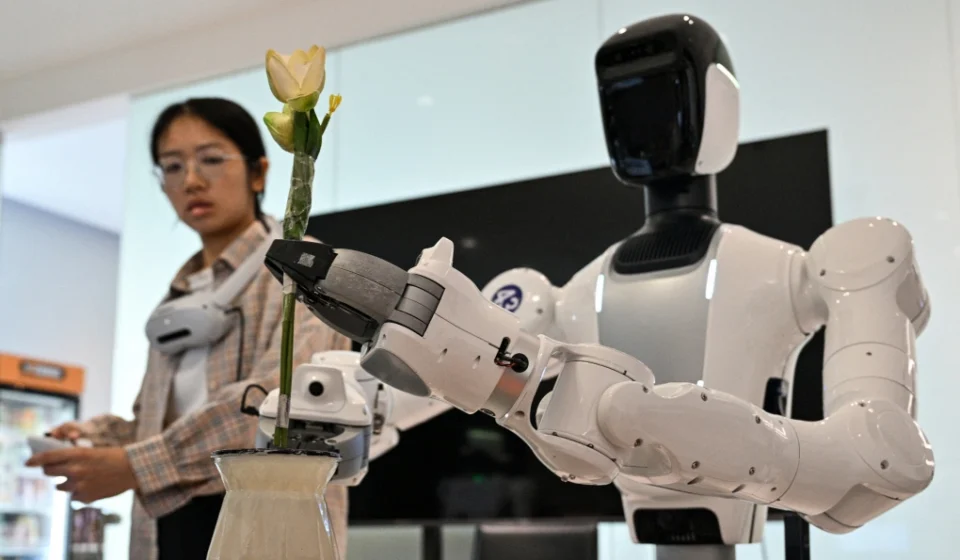
An X Square engineer trains a robot to arrange flowers at the company’s office in Shenzhen. Photo: AFP
An X Square engineer trains a robot to arrange flowers at the company’s office in Shenzhen. Photo: AFP
X Square engineers also said the service is intended to let robots operate in unfamiliar environments. “This comes with many challenges, but abnormal data is also very useful for robot development,” Hu said.
As investment in embodied AI increases, many similar trials are taking place in China, including robots directing traffic in Hangzhou and operating in factories. GigaAI also plans to deploy 100 humanoid robots to households in Wuhan this autumn for free domestic-helper trials.
Investors poured nearly 58 billion yuan, or 8.5 billion USD, into China’s embodied AI industry in the first half of this year, far exceeding the total investment for all of last year, according to the ITjuzi database.
Still in Its Early Stages
Experts say it will be a long time before the technology can be deployed on a large scale.
Quanta X1 Pro’s attempt to fold clothes shows that robots still cannot match human dexterity. “Although companies are trying to build better hands, along with autonomous control capabilities, we still have not achieved that,” Mavrogiannis said.
Even if the technology improves, many issues remain unresolved. One of them is privacy, as robots could gain access to large amounts of personal data. “We cannot know where the data will be sent or stored, or who will be able to view it,” warned Valeria Chira, a PhD researcher at Queensland University of Technology in Australia.
The safety of customers and their homes is another unanswered question. “I think the technology is still at a very early stage,” said Yang Jianfei, a researcher at Nanyang Technological University in Singapore.
Robots currently require human supervision, with operators needing the ability to activate an emergency stop function. At the same time, there is still no industry-wide recognized safety standard for robotics.
Lin Meiqiong did not seem worried when asked whether robots might revolutionize her line of work. “Compared with humans, it clearly still cannot do many things. It is still just a robot,” she said.
Diep Anh, according to AFP