
The FIFA World Cup 2026 will take place from June 11 to July 19 with 48 teams competing, an increase from 32 teams in recent tournaments. However, before the event, many supercomputers and AI systems have also showcased their prediction abilities with varying results.
This year, the models indicate that the championship odds for any team do not exceed 20%, suggesting that the World Cup 2026 is viewed as one of the most balanced tournaments in decades. Nevertheless, the models show certain discrepancies, reflecting a common characteristic of sports forecasting AI: the outcomes heavily depend on input data, algorithm weights, and assumptions about each team’s performance, leading to significant variations in the results of top contenders across different simulation systems.

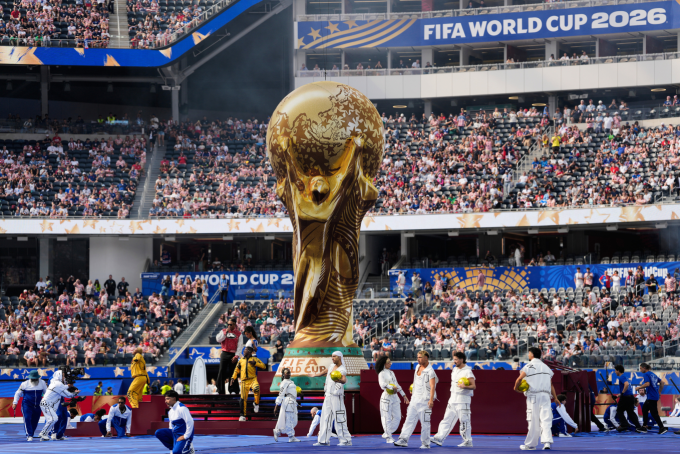
The opening ceremony of the World Cup at SoFi Stadium in Los Angeles, USA, on June 13. Photo: AP
The opening ceremony of the World Cup at SoFi Stadium in Los Angeles, USA, on June 13. Photo: AP
Opta: Spain
Considered the most renowned supercomputer in the sports world, Opta predicted earlier this month that Spain is the strongest contender, with a 16.1% chance of winning. Following are France (13%), England (11.2%), Argentina (10.4%), and Portugal (7%). Opta has previously gained fame for its high accuracy in predicting match outcomes compared to other supercomputers.
To make its predictions, Opta’s system first calculates the probabilities of each match outcome – win, draw, or loss – based on data from betting markets and Opta Power Rankings. These metrics are formed from historical performance as well as the recent form of each team. The model then assesses the strength correlation between each opponent and simulates the entire tournament thousands of times.
For the World Cup 2026, Opta conducted up to 10,000 simulations. By analyzing the results of each scenario, the supercomputer determines the frequency of each team advancing to different stages or winning the championship. These frequencies are then converted into probabilities and form the basis for pre-tournament forecasts.
ULMS: Spain
The supercomputer from the University of Liverpool Management School (ULMS) predicted that the FIFA World Cup 2026 final will be a clash between England and Spain, with Spain being considered the more promising candidate for the championship. This supercomputer previously accurately predicted England’s second-place finish at Euro 2024.
According to results published on the science, research, and technology news aggregator Phys.org, ULMS stated that the supercomputer utilized the latest machine learning technologies to predict match outcomes. Factors considered include squad quality, player form, and how they interact on the pitch.
After conducting 1,000 simulations, the supercomputer predicts England’s chance of winning in the final at 17%, lower than Spain’s 26.1%. Other closely competing rivals include France (13.5%), reigning champion Argentina (12.4%), and Portugal at 10.6%.
“Compared to 2024, we have added simulations for injuries, suspensions, and who scores, even considering match conditions, weather, and altitude. These are crucial factors in this large-scale tournament taking place in three host countries,” said Dr. Benjamin Holmes from ULMS.
JeffBet: England
The JeffBet supercomputer (UK) made early predictions last year, believing that England would face Portugal. Here, Harry Kane and his teammates would lift the trophy for the first time since 1966. Previously, England would overcome rivals including France in the quarter-finals and reigning champion Argentina in the semi-finals.
JeffBet’s model uses data on form, rankings, head-to-head results, and squad strength to simulate the entire tournament thousands of times to determine the most likely scenarios. However, the detailed parameters and methodologies of the predictions have not been fully disclosed, making the results mainly for reference.
PELE: Spain
PELE, the new football model from the renowned data analysis blog FiveThirtyEight (USA), conducted up to 100,000 simulations, taking into account the difficulty of each match bracket, criteria for tiebreakers, and even the potential for a dark horse candidate to perform exceptionally well. The model continues to run results after the outcomes of the opening matches are known.
The latest updated data from PELE on June 13 shows that Spain and France are the two teams with the highest chances of winning, each with a 16% probability. Following them are Argentina and England. However, the supercomputer also emphasizes that the gap between the top six candidates is relatively small, meaning a team like Argentina, Brazil, or England could potentially win if they perform well in the knockout stage.
The Sun’s Prediction Chooses Argentina
The Sun (UK) also employed an AI Consensus Model late last year, running over 100 simulations across 10 different data models including Le Chat from Mistral AI, Nova from Amazon, Claude from Anthropic, ChatGPT from OpenAI, Grok from xAI, which utilized factors such as squad value, historical performance, and match statistics to make predictions.
After running through all simulations and knockout scenarios, the AI ultimately recreated the final match similar to 2022: France vs. Argentina. In this match, Lionel Messi’s team would successfully defend their title.
SMH: Spain
The Sydney Morning Herald (SMH – Australia) ran its own AI called the “Monte Carlo simulation” to determine the team most likely to win the tournament. The team requested the system to simulate 100,000 different matches among the 48 teams for the 104 matches of the World Cup 2026. Considered metrics included player form, classification of strong and weak teams, and potential unexpected occurrences.
The result showed Spain leading the simulations with a basic win rate of 16.1%, while the Austria team only achieved a win rate of 0.10%, ranking 33rd out of 48 teams.
Popular AI Models
Mistral AI: “Spain has strong grounds to win the World Cup 2026 due to its young, talented squad that is at peak form after winning Euro 2024.”
Anthropic Claude: “Brazil, due to its young squad, significant attacking energy, and a strong desire after over 20 years without a championship. Competing in America also provides benefits in terms of time zones and fan support.”
OpenAI ChatGPT: “France, as this is the team with the best squad depth, many stars are in their prime, and they have extensive experience from participating in many finals.”
xAI Grok: “Spain, they will face France or England in the final and claim the championship. This is the team currently exhibiting the best form and balance.”
Google Gemini: “Spain, they will rise to the top thanks to a remarkable performance streak, team uniformity, and legacy.”
Bao Lam summarized.