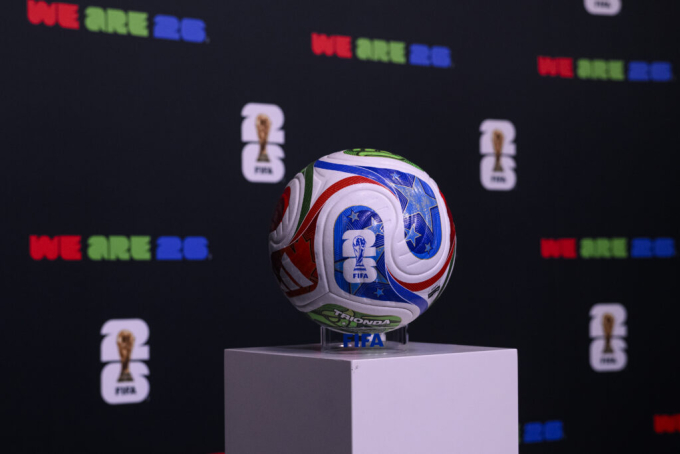

The ball, named Trionda, features a textured surface with deep grooves along with the symbols of the maple leaf, green eagle, and star, representing the three host countries. Through experiments in a wind tunnel, research teams from Purdue University (USA) and Tsukuba University (Japan) found that the ball improves stability, but may not travel as far as previous ball versions.
“Trionda might shorten extremely long kicks a bit, but in return, it offers a more predictable flight path,” said team member John Eric Goff, a sports physics researcher at Purdue University. The biggest differences will be seen by goalkeepers, defenders making long passes, and players taking long shots, according to the expert.

Trionda, the ball for the 2026 World Cup. Photo: FIFA
Adidas has designed a new ball for each World Cup since the 1970s. Changes in the first few decades were primarily aesthetic. The 1986 ball featured graphics inspired by the Aztec temple for the tournament in Mexico, while the 1994 ball had a space pattern to commemorate the 25th anniversary of the Moon landing. There were some minor structural differences, such as upgraded foam cores and water resistance, but overall, the ball still consisted of 32 hexagonal panels stitched together.
This began to change at the 2006 World Cup in Germany, when Adidas introduced the +Teamgeist ball, which had only 14 curved panels, bonded by heat instead of stitching. This design prevents moisture from entering, so the ball does not become heavier as the match progresses, Goff said.
Since then, he and his colleagues have tracked the changes as Adidas released balls with different surface textures and varying numbers of curved panels—adjustments significant enough to influence gameplay. He has worked with a team in Japan to analyze how the flight behavior of World Cup balls changes with each new design.
Experiments conducted at Tsukuba University in Japan have been maintained over the years to ensure continuity and provide visual comparative data, according to Takeshi Asai, a professor at the school. They performed this by attaching the ball to a metal rod. This rod is connected to a device called a force sensor, used to measure aerodynamic forces such as drag and lift when the ball encounters wind speeds ranging from 7 to 35 meters per second, similar to those in a real match.

The research team tests the aerodynamics of the Trionda ball. Photo: MIT Technology Review
The team’s analysis shows how recent World Cup balls have improved since the 2010 Jabulani ball with its eight-panel structure. According to the Guardian, Jabulani faced much criticism from players, especially goalkeepers, due to its tendency to drop too quickly at the end of its trajectory.
The key drawback of the 2010 ball was its excessive smoothness. The drag coefficient was relatively low when flying at high speeds, but as the ball slowed down to a certain point, this coefficient surged, causing the ball to drop faster. If there are more surface structures such as seams and grooves, the transition occurs more gradually, and the ball has a more predictable trajectory.
“That is also why golf balls have dimples and baseballs have 108 double stitches,” Goff explained to MIT Technology Review.
Since then, Adidas has learned from past experiences. This year’s Trionda version has only four panels, but features deep connecting grooves, with each panel having three grooves to increase surface texture. However, more surface texture also comes with trade-offs. Trionda has the most stable trajectory since 2010, with the “drop” only occurring when the ball is at very low speeds, that is at the end of its trajectory. In return, the ball experiences more drag when flying at high speeds compared to other balls.
Therefore, the trajectory of long kicks may be slightly shortened, Goff noted.
Players at the World Cup have had time to adapt, approaching the new ball at least a few months before the tournament. Goff pointed out that Trionda is quite similar in design to Nike’s Flight ball, so players who have spent considerable time with the Nike ball might have an added advantage.
Adidas also conducts its own tests but does not disclose them for each new ball version. According to the New York Times, Trionda underwent a 3.5-year testing process with robots kicking the ball at various speeds.
How AI is featured in World Cup 2026
Apple releases an app for live score updates during World Cup 2026
How AI is featured in World Cup 2026
Apple releases an app for live score updates during World Cup 2026