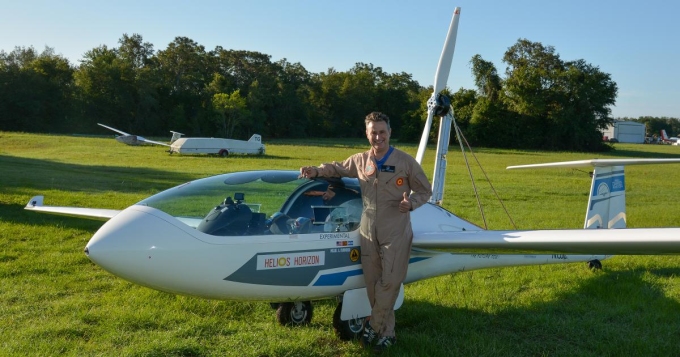

Test pilot Miguel Iturmendi, founder of Helios Horizon, conducted a series of short flights at Zephyrhills Municipal Airport in Central Florida earlier this month. According to Interesting Engineering, the aircraft used in the tests is a modified Pipistrel Taurus motor glider, originally equipped with a lithium-ion battery rated at 260 Wh/kg. However, it has been adapted to operate with a solid-state battery rated at 410 Wh/kg.
Helios Horizon states that the new battery is smaller than traditional lithium-ion batteries found in today’s electric vehicles but offers 60-80% higher energy density. Solid-state batteries replace flammable liquid electrolytes with solid materials, enhancing thermal stability and resistance to physical damage. The battery can draw power from a standard AC outlet without the need for specialized charging infrastructure. During flight, the aircraft can supplement its energy with an integrated solar panel system or operate its propellers like a wind turbine when engine thrust is not required.
The new solid-state battery can charge from nearly empty to 80% capacity in under 15 minutes. Helios Horizon aims to increase energy density by around 40% over the next two years.
“For the first time, we have battery technology that provides the range and charging time necessary to make commercial electric aviation feasible while ensuring the safety that passengers demand,” Iturmendi said. He added that energy regeneration techniques, including gliding and turning the propeller during descent, “can significantly increase range.”

Test pilot Miguel Iturmendi stands next to the solid-state battery aircraft. Photo: Helios Horizon
Helios Horizon’s spokesperson mentioned that they assembled the battery pack from solid-state cells purchased from several suppliers but declined to name them for security reasons. The organization also did not disclose the chemical composition, including the electrolyte and electrode materials, of the cells.
According to RobbReport, the test flights earlier this month mainly aimed to assess the weight and balance of the aircraft after the battery installation. Helios Horizon evaluated that the new energy system performed better than expected during continuous operation, but did not reveal specific information about range or maximum speed.
The research team is planning a flight to the stratosphere later this year, targeting an altitude above 12,100 meters, exceeding the typical cruising altitude of passenger aircraft. Iturmendi believes that the solid-state battery will enable these missions to be completed with a single charge. He previously shared with Aviation International News that the main technical challenge for electric flight in the stratosphere is cooling the propulsion system, which is difficult to achieve in the thin air at high altitudes.

Helios Horizon’s solid-state battery aircraft undergoing testing. Photo: Helios Horizon
Aerospace Global News notes that modern electric motors have good efficiency and reliability, and their mechanical design is simpler compared to traditional aircraft engines. However, the real challenge lies in storing enough energy on board.
For decades, the capabilities of electric aircraft, which often use lithium-ion batteries similar to those for electric vehicles, have been limited. While they operate smoothly, these batteries raise concerns regarding range, charging time, and performance. This is why solid-state batteries are expected to make a difference.
Helios Horizon has reached this new milestone amid ongoing efforts by aerospace companies and organizations to explore various methods for reducing emissions. Swedish company Heart Aerospace is developing the ES-30 hybrid electric aircraft, combining battery power with a backup power generation system to extend range while retaining some benefits of electrification. NASA has also spent years researching electric propulsion systems through programs like the X-57 Maxwell, helping researchers better understand the performance of electric motors, batteries, and electrical systems in aviation environments.
Thu Thảo tổng hợp