
Jeffrey Brian Straubel, co-founder of Tesla and now CEO of battery recycling company Redwood Materials, believes that America should indeed be worried. “I think the power grid cannot keep up. The rate of growth and energy demand is unprecedented,” he said at Fortune’s Brainstorm Tech conference in Aspen, Colorado, this week.
Experts agree that this concern is justified. According to the International Energy Agency (IEA), a typical data center can consume as much electricity as 100,000 households, while new ultra-large facilities can use the equivalent of two million homes. The agency also reported that global data centers will consume 415 terawatt-hours of electricity in 2024, with the U.S. accounting for 45%, followed by China and Europe with shares of 25% and 15%, respectively.
The U.S. has the largest data center scale in the world, far surpassing other countries. According to Stanford University’s AI Index, last year, the U.S. had 5,427 data centers compared to China’s 449. Meanwhile, according to Aljazeera, China’s electricity output is double that of the U.S., and this gap is expected to widen due to strong investment strategies in the national power grid.
According to Reuters, China has the largest power grid in the world. Last year alone, the populous nation added over 500 GW, raising its total capacity to 3,800 GW, which is twice that of the U.S. Research organization BloombergNEF estimates that in the next five years, China’s additional electricity generation capacity will exceed that of the U.S. by six times, primarily from renewable sources such as solar and wind energy.

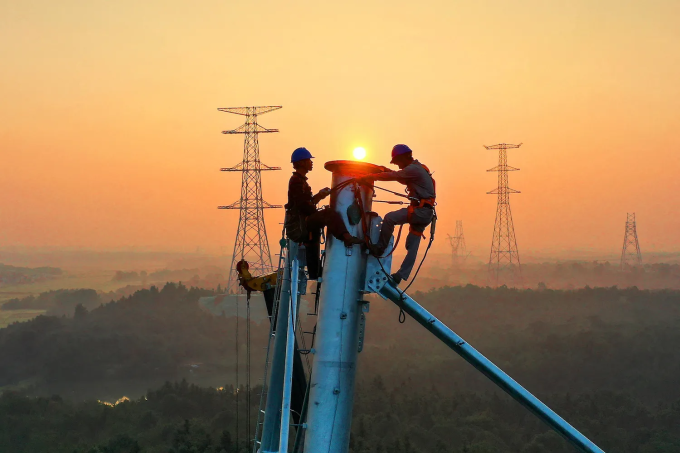
Workers are constructing a high-voltage power transmission tower in Jiangxi Province, China, September 2025. Photo: Foreign Policy
Many American tech leaders share concerns about the prospect of electricity shortages. At the World Economic Forum (WEF) 2026 in Davos, Switzerland, in January, Nvidia CEO Jensen Huang likened AI to a multi-layered cake. The top layer consists of applications, like chatbots, beneath that is software, including language models, followed by infrastructure and memory chips. The final layer—energy—plays the most crucial role.
“Energy is the core principle of AI infrastructure and the binding factor that determines the amount of intelligence that the system generates,” he emphasized.
Previously, he also noted that China has an advantage in AI infrastructure compared to the U.S. While the U.S. maintains an edge in chips, he warned that China can build large projects at a rapid pace. “If you want to build a data center in the U.S., from breaking ground to operating an AI supercomputer, it might take about three years. Meanwhile, they can build a hospital over the weekend,” Jensen Huang told John Hamre, President of the Center for Strategic and International Studies (U.S.), at the end of November last year.
In addition to the speed of infrastructure development, he is also concerned about the relative energy supply of countries to support the AI boom. “China has twice as much energy as the U.S., while the U.S. economy is larger. This seems absurd to me,” he said, noting that China’s energy capacity is still increasing sharply, almost vertically, while the U.S. is much more stagnant.
At the end of last year, OpenAI CEO Sam Altman also predicted that AI costs “will ultimately boil down to energy costs,” warning that China’s advantages could put “America’s leading position in AI at risk.”

The Digital Realities Data Center in Ashburn, Virginia, March 17, 2025. Photo: Reuters
Elon Musk, CEO of SpaceX, has warned that scaling up AI on Earth will soon hit a massive “hardware wall.” He argues it is very difficult to build or expand new AI data centers anywhere outside of China due to a severe global electricity shortage.
In a conversation with podcast host Dwarkesh Patel and Stripe co-founder John Collison, Musk remarked that the production capacity for advanced AI chips is increasing exponentially, but the world’s power grid is not keeping pace, except for China.
“The issue lies with energy supply. Electricity output outside of China is almost flat. There is a slight increase, but not much,” Musk explained. “If you build a data center anywhere outside of China, where do you get the power, especially when scaling up? How do you operate chips, with some magical energy source or relying on a ‘fairy’ of electricity?”
Earlier this year, SpaceX announced plans to launch a million satellites to serve as data centers in orbit, allowing them to bypass the limitations of terrestrial power grids. The satellite cluster will use solar panels to power AI computing hardware. According to Musk, solar panels in orbit can generate five times the electricity compared to those on the ground, which are hampered by the atmosphere.

A solar power farm in Hai Nan Prefecture, Qinghai Province, western China, July 2025. Photo: AP
“Wherever we go, people take the availability of energy for granted,” Rui Ma, founder of the media company Tech Buzz China, wrote on X after returning from a tour of AI centers in China last summer.
For American AI researchers, this seems almost unimaginable. In the U.S., the surging demand for AI conflicts with a fragile power grid. Investment bank Goldman Sachs warned that this could severely hinder the development of the industry. Meanwhile, according to Ma, in China, this is seen as a “problem already solved.”
David Fishman, an American scholar specializing in China’s energy sector, assesses that the average increase in electricity demand in China exceeds the entire consumption of Germany each year. In a conversation with Fortune last year, he shared that many rural areas in China have rooftops covered with solar panels, and even a province can generate electricity equivalent to that of an entire country.
Fishman noted that China’s electricity reserve rate has never dropped below 80-100%, meaning it maintains capacity double the demand. Therefore, rather than viewing AI data centers as a threat to grid stability, the Eastern nation sees them as a convenient way to “absorb surplus supply.”
In the U.S., regional power grids often operate with a reserve margin of only 15%, sometimes lower, especially under extreme weather conditions. In places like California or Texas, authorities have repeatedly warned when energy demand is expected to put pressure on the system.
Fortune noted that the differences between the two AI powerhouses are stark. The U.S. grapples with political and economic debates over the ability to meet power grid demands, while China operates AI with an ample energy supply.
Thu Thảo tổng hợp