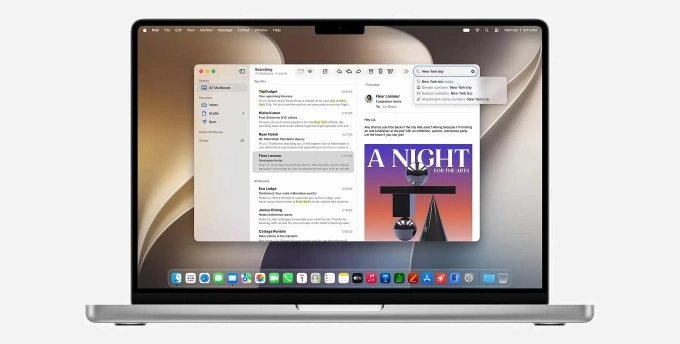

According to the announcement made at the Worldwide Developers Conference (WWDC) 2026 on June 8 in the United States, Apple stated that macOS 27 Golden Gate will no longer run on any Mac using Intel chips. Instead, only models equipped with M1 chips and above will be able to upgrade to the new operating system version.
This announcement was not surprising. Last year, when introducing macOS 26 Tahoe, Apple indicated that it would be the last version available for Macs with Intel chips. According to Engadget, since these models were launched before 2020, Apple has actually provided a relatively long support period.
However, Apple will not completely “retire” Intel-based Macs. The company will continue to release security updates for these machines until 2028.

The interface of macOS 27 Golden Gate on MacBook. Photo: Apple
Apple decided to part ways with Intel in 2020 when it developed its own M Silicon chips, which were equipped in the first three models including the MacBook Air M1, MacBook Pro 13-inch M1, and Mac mini M1. The decision to shift from Intel chips to in-house products was seen as a gamble for the company in the computer chip space, but it quickly became a success. This chip line has now evolved to its fifth version (Apple M5) along with the M5 Pro and M5 Max variants, but the M5 Ultra has not yet been announced.
The macOS 27 Golden Gate operating system was introduced by Apple at WWDC 2026 with a host of new features. While macOS 26 Tahoe focused on the Liquid Glass interface, Golden Gate is an upgrade centered around three pillars: Siri AI, smart system-wide search, and performance optimization.
Among these, Apple is placing the strongest focus on Siri AI. The new virtual assistant has the ability to maintain multi-step conversations, understand context from previous requests, and handle tasks related to personal data on the device. Users can search for emails, photos, notes, or documents using natural language, request cross-referencing information between multiple documents, or perform a series of actions within the system. Apple has also added a dedicated Siri app that allows users to save chat history and sync across Mac, iPhone, and iPad.

Siri AI can perform many tasks on Mac. Photo: Apple
Spotlight has been redesigned to become a search and task execution tool across the system. Users can input commands in natural language to find data across multiple applications or perform actions without needing to open the corresponding app. Apple stated that the indexing system of Spotlight has been changed to process data faster and support context-based searching.
Additionally, Apple has completely overhauled and restructured the content indexing method, addressing the issue of Finder failing to search for files, folders, and applications on Macs, a problem that has persisted in previous versions.
Golden Gate is the first version to bring Visual Intelligence to Macs. This AI feature can recognize content displayed on the screen, analyze images, summarize text, and answer questions related to the content users are viewing. Users can activate this tool from anywhere in the operating system with a specific shortcut.
The Shortcuts app also integrates the ability to create automated workflows using natural language. Instead of setting up each step manually, users only need to describe the task to be performed in text or voice. The system will create a corresponding icon based on that request.

The Shortcuts app across Apple platforms. Photo: Apple
In terms of interface, Apple continues to use Liquid Glass but has adjusted some components. According to 9to5mac, over the past year, users have complained that this interface was inconsistent across the system, and macOS 26 has addressed this issue. Users can adjust the transparency level of the interface via a dedicated slider. Apple has also changed how icons are displayed in the sidebar of applications and adjusted some window components.
In the new macOS, AI is integrated more deeply. Many system applications have added tools related to artificial intelligence, such as Safari managing tabs using AI; Mail and Notes supporting semantic search; Photos including image editing tools; or Image Playgrounds assisting in image editing, creating contact avatars, and wallpapers. Apple has also updated Screen Time and parental management features.
In addition to new features, Apple stated that macOS 27 Golden Gate focuses on optimizing the system platform, including changes to some components to improve application launch speeds, data processing, and interface responsiveness. The first beta version for developers was released immediately after WWDC 2026, with a public beta expected next month and the official version anticipated to be available for all users in the fall of this year.
Bao Lam – Tuan Hung
Images of Vietnam featured multiple times at the Apple event
Apple introduces iOS 27, supporting iPhone 11
Apple teams up with Google to ‘revive’ Siri
Images of Vietnam featured multiple times at the Apple event
Apple introduces iOS 27, supporting iPhone 11
Apple teams up with Google to ‘revive’ Siri