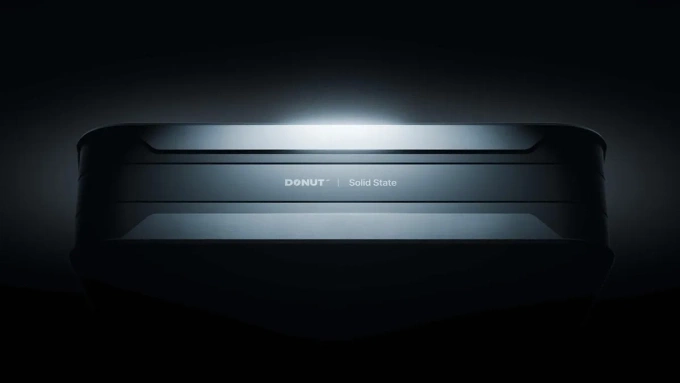

At CES 2026 in January in Las Vegas, Marko Lehtimäki, CEO of Donut Lab, attracted attention by claiming the successful development of a solid-state battery. According to advertisements, the battery achieves an ultra-high energy density of 400 Wh/kg, a lifespan of 100,000 charge cycles, and takes less than 10 minutes to fully charge. This achievement was seen as surpassing major players in the battery industry, quickly elevating Donut Lab’s valuation to 1.25 billion USD.
However, on June 8, Ryan Inis Hughes, the owner of the YouTube channel Ziroth, announced the results of an investigation he conducted in collaboration with over 20 battery experts from the Fraunhofer Institute and several major universities, confirming that Donut Lab’s solid-state battery actually contains a core of conventional lithium-ion technology.

According to The Verge, Donut Lab had previously provided test results from the VTT Research Center (Finland). However, experts analyzed the data and identified two suspicious indicators. First, during charging, Donut Lab’s battery maintained a stable voltage level of 3.7-3.8V, which is characteristic of high-nickel NCM lithium-ion batteries. Next, when charged to 50-70%, the battery displayed breakage on the elasticity graph due to ions rearranging at the anode, a phenomenon that occurs in conventional lithium-ion batteries.
Additionally, the actual energy density measured by experts reached a maximum of 298 Wh/kg, hitting the upper limit of current battery technology and falling far short of the claimed 400 Wh/kg.
Donut Lab is believed to have sourced batteries from the German company CT Coatings. Although it promised to supply Donut Lab with solid-state batteries based on sodium using silk-screen technology, CT Coatings only delivered a batch of lithium-ion batteries. Leaked emails indicate that Donut Lab continuously requested evidence of technology from its partner but received no response. Nonetheless, the Finnish startup continued to make misleading advertisements.
Representatives of Donut Lab have not commented, while the Finnish financial regulatory authority and police are launching an investigation.
According to CNet, before Hughes, several websites specializing in electric vehicles and batteries expressed skepticism, such as Electrek. In April, this site published allegations that Donut Lab was a fraud. They also published an article in January stating that in a few months, CEO Marko Lehtimäki would be proven as “either a world-changer or a fool.”
Rather than using liquid electrolytes like traditional batteries, solid-state batteries employ solid or gel electrolytes, allowing for higher energy density, meaning more capacity within the same physical area, as well as superior longevity and safety. While lithium-ion batteries degrade after 300-500 charge cycles, experimental solid-state battery models retain 80% capacity after 1,000 charges.
Many major companies are pursuing this technology, including Toyota, Samsung, Honda, and Nissan, but most have set a rollout timeline for 2027-2029. The reason is that while the batteries perform well in the lab, producing millions of identical cells will require additional testing time.
Huy Đức compiled the report.