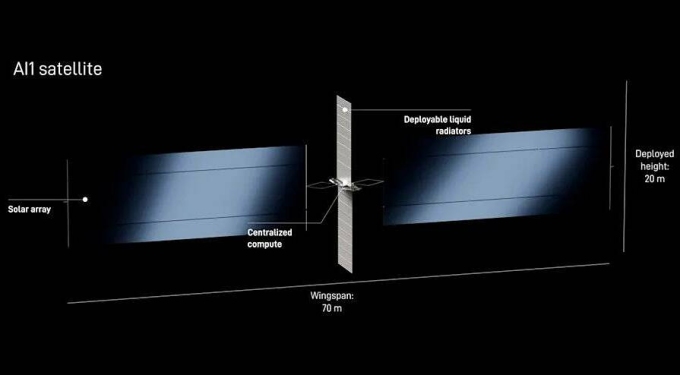

In a video posted on SpaceX’s X account on June 9, billionaire Elon Musk revealed the detailed design of AI1, the first generation in a series of satellites the company plans to use as an orbital data center. AI1 stands 20 meters tall and has a wingspan of 70 meters, surpassing the 68.4-meter wingspan of the Boeing 747-8, and could become the largest satellite ever launched by SpaceX.
The design of AI1 essentially consists of a computing module, a large solar panel system, and a liquid cooling radiator that can retract and expand. Musk estimates the computing power of the AI1 satellite is equivalent to an Nvidia GB300 cabinet. It has an average computing power of 120 kW, a maximum of 150 kW, with an efficiency announced by SpaceX of 70 kW/ton when operating at an altitude of 600 km. The solar panel system utilizes SpaceX technology and provides 250 W of electricity per square meter.
AI1 can flexibly change its computing hardware, meaning SpaceX is not tied to a single chip manufacturer. Tom’s Hardware noted that this flexible replacement capability could be crucial for Musk, especially since SpaceX currently cannot ensure its own chip supply.

The AI1 satellite design. Photo: SpaceX
AI1 is equipped with a liquid cooling system covering 110 square meters, backup pumping loops, and a micro-meteoroid shield. According to research and consulting firm SemiAnalysis, for comparison, the thermal control system ETACS of the International Space Station (ISS) dissipates about 70 kW of heat—half of what is needed to cool a GB300 cabinet—over a cooling area of 422 square meters at a cost of up to 500 million USD.
Musk has dismissed concerns about the cooling capabilities of the orbital data center. In an interview with SpaceNews in March, he stated, “I can confirm SpaceX knows how to cool in space,” referring to the experience of operating a network of over 10,000 Starlink satellites.
In the post on X on June 9, Musk mentioned that building satellites for the data center is simpler than Starlink. “Basically, the AI satellites consist of many solar panels and a cooling system. You still need some laser links, but you don’t need the ultra-complex antennas like Starlink,” he said, asserting that the new satellites need to be larger than currently operational Starlink satellites. By leveraging hardware and manufacturing processes developed for Starlink, Musk believes SpaceX can quickly transition from concept to actual production.
Theoretically, the AI1 satellites will form a cluster of orbital data centers that could eventually achieve terawatt-level computing power. Musk noted that AI1 is currently SpaceX’s first and best effort to tackle AI computing issues in space. The company has not made any commitments regarding timelines or the scale of deployment.
The new Gigasat Factory
SpaceX also announced plans to build a new factory named Gigasat in Bastrop, Texas, with an area up to 1,000,000 square meters, ten times larger than Starfactory, SpaceX’s largest current spacecraft manufacturing complex.

The Gigasat factory construction project in Bastrop, Texas, USA. Photo: SpaceX
The factory is expected to produce solar cell wafers, solar panels, printed circuit boards, silicon electronic components, user terminals, connectors, and the AI satellites themselves.
Musk stated that the solar energy equipment manufacturing facility is under construction, while the AI satellite manufacturing facility is about to break ground. SpaceX anticipates producing a “significant amount” of these satellites by the end of 2027. Although each satellite achieves a maximum computing power of 150 kW, the company aims to reach 1 GW of AI computing power in space each year, corresponding to launching over 6,000 AI1 satellites.

The SpaceX logo next to a model of a small satellite. Photo: Reuters
In January, SpaceX submitted an application to the U.S. Federal Communications Commission (FCC) proposing to launch one million satellites as orbital data centers. The company has signed several computing agreements, including a $920 million monthly contract with Google.
However, Musk’s ambitions face significant skepticism. In February, OpenAI CEO Sam Altman described the intention to build an orbital data center as “ridiculous” at present due to the technology not being fully developed.
Dr. Robert Zubrin, designer of NASA’s Space Launch System (SLS) prototype, also told Forbes, “The plan to build a huge and costly AI data center satellite system is so unbelievable that it could lead to SpaceX’s financial collapse.”
Compiled by Thu Thao