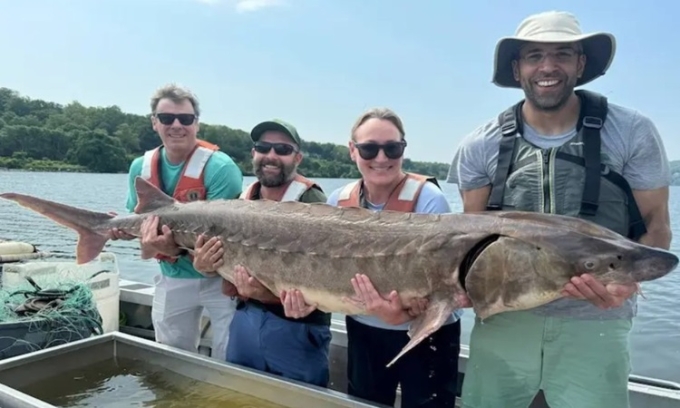

According to Popular Science, the mysterious low rumbling sound resembling thunder emanating from the brackish waters of the Hudson River in New York, USA, is produced by the spawning behavior of the Atlantic sturgeon (Acipenser oxyrinchus), an endangered species. In an article published in the journal Endangered Species Research, a research team led by ecologist Rebecca E. Cohen at Cornell University confirms that the deep thunder sound is generated by male sturgeons thrashing vigorously to fertilize the eggs, resonating with the vibrations of the bubbles within their bodies. In the spring, Atlantic sturgeons swim upstream from the ocean into the Hudson River to spawn. In this giant fish species, the eggs are not fertilized inside the females. Instead, females release up to 2 million eggs into the water while males release sperm-laden fluid. The research team notes that another species, the lake sturgeon, also produces similar low-frequency sounds during the spawning season.

A 1.8-meter-long sturgeon caught in the Hudson River during an environmental survey in June 2024. Photo: New York State Department of Environmental Conservation
A 1.8-meter-long sturgeon caught in the Hudson River during an environmental survey in June 2024. Photo: New York State Department of Environmental Conservation
According to Scientific American, researchers are uncertain whether the thunder-like sound is a form of communication among sturgeons or simply a byproduct of the spawning activity. The research team listened to this crucial life stage by using passive acoustic monitoring devices. They recorded sounds in the Hudson River with underwater microphones over an extended period. Although this non-invasive method is common in marine and terrestrial research, it has not been widely applied in rivers and freshwater lakes. The discovery of the thunder-like sounds from Atlantic sturgeon provides the New York State Department of Environmental Conservation (NYSDEC) with a new way to monitor this species more effectively. In the 19th and 20th centuries, overfishing led to a significant decline in sturgeon populations, which have not recovered after nearly 30 years of protection. Part of the issue lies in the fact that female Atlantic sturgeons take two decades to spawn for the first time. The eggs can comprise 20% of the female’s weight, and fishermen pay close attention to harvesting sturgeon eggs due to their high economic value. Consequently, they may face extinction due to their slow reproductive rate. The Hudson River is home to the largest population of Atlantic sturgeon. In the late 19th century, the Hudson housed 6,000 Atlantic sturgeons, but today, their numbers have dwindled to just 700.

The deep rumbling noise produced by Atlantic sturgeon. Video: Popular Science
The deep rumbling noise produced by Atlantic sturgeon. Video: Popular Science
In the future, the research team may uncover previously unknown spawning areas, helping authorities implement measures to protect this endangered fish species.
The Atlantic sturgeon (Acipenser oxyrinchus oxyrinchus) is a prehistoric fish species belonging to the sturgeon family, existing on Earth for over 120 million years. Males can weigh up to 41 kg while females can weigh 72.5 kg. Sturgeons can live for over 60 years. Males do not mature until at least 10 years old, while females take nearly 20 years to reach maturity.