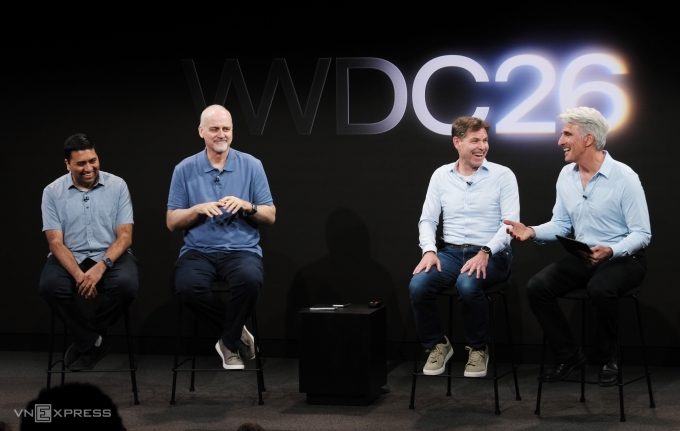

After the keynote speech at WWDC 2026 on June 8, Apple held a detailed discussion about technology with a limited number of media guests, featuring Craig Federighi, Apple’s Senior Vice President of Software; Amar Subramanya, Vice President of Artificial Intelligence; Mike Rockwell, head of the Siri department; and Sebastien Marineau-Mes, Vice President of Software.

From left to right: Amar Subramanya, Vice President of Artificial Intelligence at Apple; Mike Rockwell, head of the Siri department; Sebastien Marineau-Mes, Vice President of Software; and Craig Federighi, Senior Vice President of Software. Photo: Tuan Hung
Collaborating with Google
“We do not use Google Gemini,” Craig Federighi stated, adding that Apple also does not utilize any Gemini model being deployed for Google customers, Google Search infrastructure, or anything similar as the backbone of the company’s machine learning knowledge. Instead, the company collaborates with Google to develop its own model, the Apple Foundation Model (AFM) generation three.
According to Subramanya, the new Foundation Model includes two models operating directly on the device and three models on the server. The device operational group consists of AFM Core, which uses dense architecture, and AFM Core Advanced, which employs sparse architecture and is natively multimodal. He noted that AFM Core Advanced “is completely different from any device model the company has ever implemented,” allowing for the addition of new features, including interaction requests and expressive voice capabilities without the need to send commands to the server.

Mike Rockwell introduces the Apple Foundation Model generation three. Photo: Tuan Hung
The two cloud models mentioned first are AFM Cloud, optimized for low latency and cost, and AFM Cloud Image, which supports image creation and editing, such as the new angle-changing feature from Apple Intelligence.
According to Subramanya, the four models mark a significant collaboration with Google. “All are specifically designed for Apple Silicon chips, trained with proprietary data using reinforcement learning methods and fine-tuned using output results from Gemini’s pioneering models,” he said. Google’s contributions are based on Apple’s selection rather than applying the entire Gemini as rumored.
Apple’s fifth and most powerful model is AFM Cloud Pro, designed for AI agents and complex reasoning tasks, with quality that Subramanya asserts is “comparable to the most advanced Gemini models.” This model also marks a turning point with Apple’s Private Cloud Compute service.
User Privacy and Private Cloud Computing (PCC)
Private Cloud Compute (PCC) is used by Apple for private AI processing, keeping requests from Apple Intelligence secure while still processing data in the cloud. Previously, PCC was limited to Apple Silicon servers in Apple’s data centers, but this year the company is working with Google and Nvidia to expand its PCC infrastructure to Google Cloud systems running Nvidia GPUs without compromising privacy and security. Marineau-Mes stated that Apple wishes to use the latest Nvidia chips but requires them to be configured in such a way that the content on Apple’s servers cannot be read.

Craig Federighi introduces the new Apple Intelligence. Photo: Tuan Hung
According to Sebastien Marineau-Mes, user data is only sent to the server with a specific action, and Apple does not have access to it. This system can be verified by independent researchers to demonstrate Apple’s commitment. Apple representatives also emphasized that any data sent to PCC will be completely erased after the request is completed. The security system is so robust that even the engineers cannot access it for debugging while it is running.
The most important point that helps Apple’s system secure users’ private data is that the company fully controls the deployed software, and Apple devices only communicate with code that has been verified by Apple.
The New Siri, Functioning with Personalized Context
Mike Rockwell, head of the Siri department, shared that Apple “completely dismantled” the old version of Siri to rebuild from scratch based on the new AI model. Previously, the company had tried to gradually improve Siri on the old platform, but his team felt they could not convey the vision and experience they wanted.
The Siri AI is built on the AFM model, natively multimodal, trained from the ground up to understand, process, and simultaneously combine various types of data such as text, images, audio, and video. The new Siri still ensures security and consistency across the entire range of the company’s devices, including iPhone, iPad, Mac, and Vision Pro.
Rebuilding Siri allows the assistant to use users’ personalized contexts to perform complex tasks while still ensuring privacy through a combination of on-device processing and Private Cloud Computing (PCC).

Mike Rockwell demonstrates Siri’s ability to process user requests based on messages on the device. Photo: Tuan Hung
In a live demonstration, Mike Rockwell asked Siri about the items people would bring to a BBQ party. The virtual assistant retrieved relevant information from messages on the device, such as who was bringing watermelon and who was bringing pasta. Then, Siri continued to suggest suitable drinks based on knowledge from the internet, showcasing the combination of private data search on the device, coordinated with public data research to provide the final result.
In another example, Sebastien Marineau-Mes demonstrated Siri’s ability to read and understand the content displayed on the screen. For instance, when viewing a cloud photo, a user might ask, “Why does the cloud look like this?” Siri would analyze the image to provide an answer. It also allows users to ask questions like, “Am I free on that day?” when viewing a friend’s message inviting them to a concert at a specific time.
Craig Federighi stated that the new Siri is not just a discrete chatbot but a deeply integrated conversational tool, capable of combining data from the user’s device. Having a separate application, unlike before, will help users easily manage and revisit past conversations.