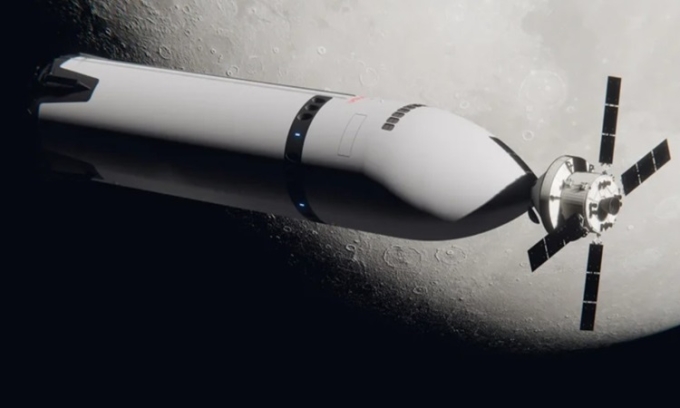

According to information shared by NASA during a ceremony on June 9, four astronauts, including Commander Randy Bresnik, Pilot Luca Parmitano, Mission Specialist Frank Rubio, and Andre Douglas, will launch aboard the Orion spacecraft in the second half of next year as part of the Artemis 3 mission. Upon entering low Earth orbit, they will test Orion’s ability to connect with two lunar landers developed by SpaceX and Blue Origin. Jeremy Parsons, NASA’s Artemis program manager, emphasized, “Artemis 3 will be an incredibly exciting, complex, and highly coordinated multi-mission launch operation. This mission will take place over a short period with three of the world’s most powerful rockets.” According to Universe Today, the Artemis 3 mission is more complex than usual because, for the first time in history, NASA will coordinate a launch campaign involving three separate spacecraft from multiple providers. NASA’s Space Launch System (SLS) rocket will lift off from Kennedy Space Center in Florida, USA, sending the four-person crew aboard Orion into Earth orbit at an altitude of 467 kilometers, which is 64 kilometers higher than the ISS. SpaceX’s Starship lander and Blue Origin’s Blue Moon Mark 2 will launch independently and wait in orbit to rendezvous with Orion and establish a connection. At least one crew member will enter the lander to check the hatches, life support systems, and new Axiom space suits. According to Parsons, after two weeks in orbit, Orion will land in the Pacific Ocean for recovery, similar to the flight of the Artemis 2 astronauts in April. “The complexity of integrating multiple spacecraft launches, rendezvous, and connections is significantly greater than in the Artemis 2 mission,” Parsons told Space.

A simulation of SpaceX’s Starship docking with Orion. Photo: NASA/SpaceX
According to Scientific American, both SpaceX and Blue Origin are competing to provide crewed vehicles for landing on the Moon. SpaceX’s lander is a variant of the giant Starship rocket, but the vehicle has yet to achieve its target orbit despite completing dozens of test flights. Blue Origin is also developing the Blue Moon lander to be launched atop the new New Glenn rocket. However, the company faced significant setbacks after the New Glenn rocket exploded during an engine test on the launch pad on May 28, destroying some critical infrastructure. David Limp, Blue Origin’s CEO, is committed to getting New Glenn flying again before the end of this year. If everything goes according to plan, the Artemis 4 mission will launch in early 2028, sending astronauts to the Moon. The next mission, Artemis 5, is also expected to launch that same year, landing on the lunar surface to begin the construction of a permanent base. According to the BBC, many industry experts are skeptical about NASA’s ability to meet this timeline. They express concerns about the slow development of Starship and Blue Moon, as well as the lack of in-orbit refueling tests. Dr. Simeon Barber at the Open University in the UK shared, “I wouldn’t be surprised if China lands on the Moon first. The lander, the most technically challenging part of the mission, is also the part NASA has the least direct control over.”
An Khang summarized.