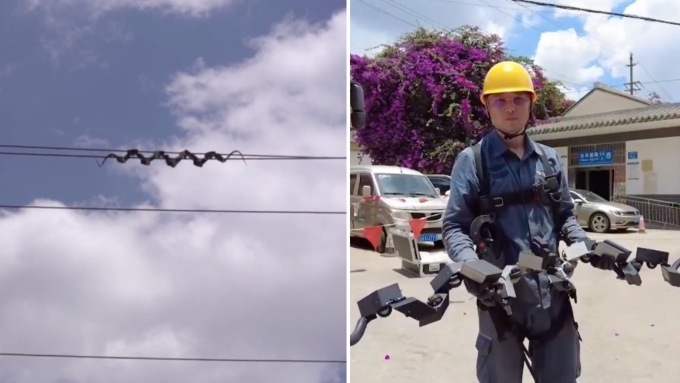

According to Interesting Engineering, the snake robot developed by the Quan Du Electric Supply Authority has completed inspections of over 130 kilometers of power lines in Kunming, the capital of Yunnan province. These robots have a flexible body with multiple joints, allowing them to wrap around and crawl along the wires, even overcoming obstacles such as insulators. Utilizing integrated cameras and sensors, they detect issues such as broken or damaged wires, worn components, or abnormal temperatures to address problems promptly.

The snake robot works on power lines (left) and on the hand of a worker. Photo: Xinhua
The snake robot works on power lines (left) and on the hand of a worker. Photo: Xinhua
Inspecting power lines using traditional manual methods is often labor-intensive and dangerous. According to the Quan Du Electric Supply Authority, the snake robot operates three times more efficiently, helping to reduce the need for strenuous labor while increasing safety.
In China, drones are relatively widely used for maintaining power transmission systems. However, snake robots can perform more direct inspections as they crawl directly on the wires. They can also access areas where drones are restricted, such as no-fly zones near airports.
Additionally, snake robots are less affected by high-voltage electromagnetic interference, a common challenge that can disrupt control systems and reduce the image quality of drones. The new robot model is equipped with a contactless energy harvesting system, allowing it to draw electricity directly from the wires being inspected, thus overcoming the battery life limitations of drones.

The snake robot works on power lines. Video: NC
The snake robot works on power lines. Video: NC
After successful trials on various power transmission lines, operators have expanded deployment to more complex power grid areas. Additionally, they have deployed dog robots, drones, and surveillance cameras to monitor electrical infrastructure and maintain a stable power supply during China’s national college entrance examination, known as Gao Kao, last week. This is one of the most important academic exams in the country, with approximately 12.9 million candidates participating this year.
According to Reuters, China has the largest power grid in the world and continues to develop at a rapid pace due to massive state investment. Last year, the populous nation added over 500 GW, raising its total capacity to 3,800 GW, double that of the United States. BloombergNEF estimates that in the next five years, China’s additional power generation capacity will be six times greater than that of the United States, primarily from renewable sources such as solar and wind energy.
Thu Thao compiled.