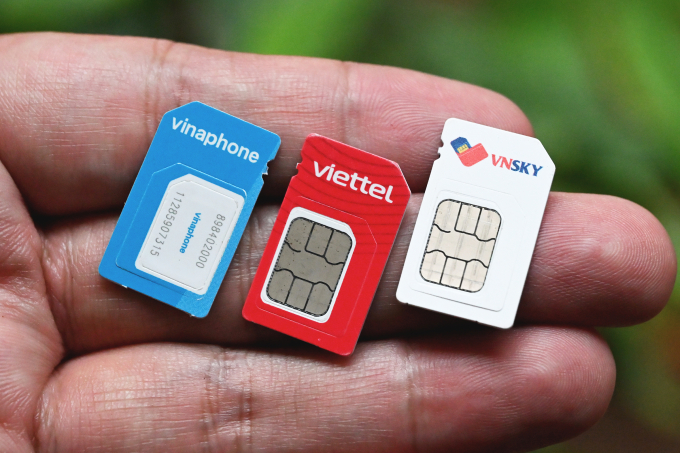

Using a phone number for over 10 years and having completed the registration of a personal SIM, Le Thanh (Hoang Mai, Hanoi) was surprised to learn that he must scan his face each time he switches to a new device. “It’s my phone number; why do I need to verify again just for changing the device?” Thanh questioned. This is also a question many people have raised as the deadline for implementing the new regulation approaches.

According to regulatory authorities, the answer lies in SIM cards that may seem like they belong to the rightful owner, but are actually in the hands of someone else. The Telecommunications Law 2023 and Decree 163 stipulate that the person registered for the phone number must bear legal responsibility for it. However, the improper lending and transfer of SIM cards still occurs.
At the end of May, the Criminal Investigation Department of Hung Yen Province prosecuted five individuals for illegally selling bank account information. This group lured many young people aged 18-20 to use their personal information to register for personal SIM cards. They established a “ghost company,” opened over 100 business bank accounts, and transferred SIM cards and accounts to others in Cambodia, illegally profiting nearly 500 million VND.
Previously, in November 2025, Da Nang police dismantled a ring using a server system, computing devices, and unregistered SIM cards to create multiple accounts on Telegram, Viber, Tinder, Zalo, etc., for the purpose of fraud and organizing gambling.
In a discussion with VnExpress, a representative from the Telecommunications Department stated that there is still a situation where SIMs are registered with complete information, but the users are not the rightful owners. There are cases where a user’s information is misused to register a SIM, which is then sold to someone else. There are also instances where users abandon their SIM cards but forget to cancel the service, inadvertently creating opportunities for malicious actors to exploit.
Solving the Issue of Non-Registered SIMs
In 2023, telecom companies verified over 125 million subscriptions. As a result, 17 million subscriptions needed to be processed, with 6 million being blocked and 11 million having their information standardized. Nevertheless, according to the Telecommunications Department, the number of junk SIMs and pre-activated SIMs “has significantly decreased but remains complex.”
During the comprehensive review of registered SIMs in 2026, just over a month into the implementation, more than 2 million phone numbers were confirmed by the users themselves not to belong to them. These numbers were subsequently subjected to one-way blocking.
Previously, dealing with non-registered SIMs was typically carried out through large-scale reviews. The new policy changes the approach: only verifying SIMs when switching devices, rather than requiring all to undergo periodic verification. This is the reason for the face verification requirement when switching SIMs to a new phone.
Specifically, the system will require users to verify their biometric information through facial recognition. This process is simple, similar to logging into a bank account or the VNeID application on a new phone.
Market research from Counterpoint Research and IDC indicates that, on average, mobile users switch devices every 3-4 years. Therefore, a telecommunications expert believes that under the new regulation, most users will only need to perform one additional small action once every few years.
“If the subscription is registered in the rightful owner’s name, each verification will only take 30 seconds to a minute,” this person stated. In return, mobile users in general will be protected in case their SIM is lost.
According to the Telecommunications Department, maintaining the rightful ownership of subscriptions will help reduce impersonation situations, decrease the supply of pre-activated SIMs, and create a technological barrier that helps telecom companies early detect unusual behaviors related to fraudulent calls and messages.
Mobile users will soon have to verify when changing phones.
Telecom companies are striving to verify millions of subscriptions before the deadline for SIM blocking.
25 million mobile subscriptions are about to be subjected to one-way blocking.
Mobile users will soon have to verify when changing phones.
Telecom companies are striving to verify millions of subscriptions before the deadline for SIM blocking.
25 million mobile subscriptions are about to be subjected to one-way blocking.