
According to Space, a research team led by Associate Professor Brian Walsh at Boston University in Massachusetts has proposed a bold solution called StormWall to strengthen the magnetosphere, the natural shield that protects Earth from intense solar storms. They used computer simulations to demonstrate that reinforcing the magnetosphere with a fleet of spacecraft could reduce the intensity of a major geomagnetic storm by more than half. If this idea becomes a reality, the StormWall system could protect vulnerable satellites, global communication networks, GPS systems, and power grids from disruptions caused by charged particles from solar storms. Walsh shared that his idea for a storm shield in space was inspired by a natural phenomenon. Materials ejected from Earth’s atmosphere and drifting to the edge of the magnetosphere would help reinforce the protective shield of the planet. Walsh and colleagues detailed StormWall in a paper published on June 2 in the journal Space Weather. During particularly powerful solar eruptions, the magnetosphere can be breached through a process called magnetic reconnection. When the solar wind’s magnetic field heads south, opposing Earth’s northward magnetic field, the field lines on both sides collide, break, and reconnect in a new structure. This process opens up a hole, allowing a large amount of solar energy to flood into the space near Earth, causing geomagnetic storms. The StormWall system is designed to prevent this process by deploying six spacecraft into geostationary orbit. Each satellite will carry materials such as barium, lithium, sodium, or calcium, which can be safely stored in solid and liquid forms and converted to gas when needed.

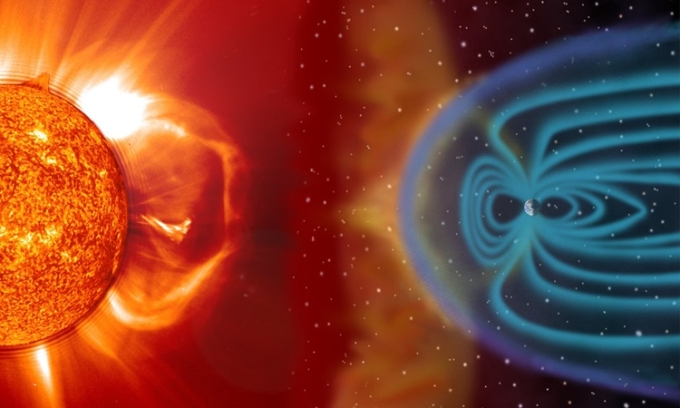
The magnetosphere acts like a giant shield protecting Earth from dangerous charged particles from solar storms. Photo: NASA
If a dangerous solar storm is detected heading toward Earth, the system operator will send a command for the fleet to release the material. Sunlight will quickly ionize the vaporized particles, turning them into a charged plasma cloud. This artificial plasma cloud will drift to the edge of the magnetosphere facing the Sun, thickening the shield between Earth and the incoming solar wind. This method effectively slows down the magnetic reconnection process, causing the solar storm to be pushed back and diverted around the planet. To test the feasibility of the idea, the research team simulated a geomagnetic storm occurring in May 2024. One model recreated the event under normal conditions, while the other simulated the storm with the StormWall plasma shield in operation. The results showed that while it does not completely eliminate the geomagnetic storm, StormWall can reduce the intensity of the storm by more than 50%. By interrupting the flow of energy at the magnetosphere boundary, the artificial plasma effectively repels solar storms. According to Eurek Alert, one of the biggest barriers to deploying StormWall is the cost. Launching six spacecraft carrying an amount of material equivalent to 12 tanker trucks is not cheap. After releasing the material and optical ionization, the system cannot be replenished and can only be used once. However, Walsh believes that StormWall still provides greater benefits in the context of private companies investing billions of dollars into space infrastructure, such as building data centers in orbit. The research team compared a “once-in-a-century” geomagnetic storm that could cause severe damage in space and on Earth, with the cost of losses in the power grid alone reaching 2.4 trillion USD. Walsh is confident that his team can reduce the costs of StormWall. Next, they plan to research how to cut the amount of material used by half, simulate the release of material in phases to extend the system’s lifespan, and seek more efficient orbits. They also want to identify the best elements to use. According to Walsh, the risk of long-term contamination from using StormWall is very low because the artificial plasma will leave the system relatively quickly, being swept away by the solar wind in about six hours instead of returning to Earth’s atmosphere.
An Khang compiled.