
The Lebanese army reported that an Israeli attack targeting a vehicle on the road connecting the city of Nabatiyeh to the town of Marjayoun today resulted in the deaths of a brigadier general, a captain, and a soldier. The identities of these individuals have not been disclosed.
The Lebanese National News Agency reported that another airstrike targeting the village of Saksakiyah in the southern part of the country resulted in six fatalities and four injuries.
“The aggressive, intentional, and repeated actions of Israel against the country, its people, and the Lebanese armed forces only strengthen our determination, faith, and steadfastness,” the Lebanese army affirmed.

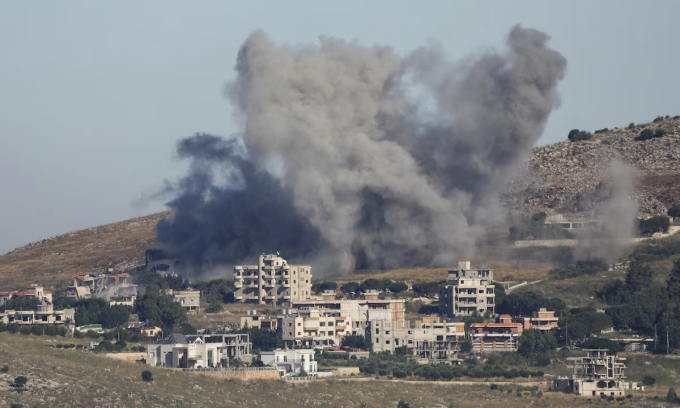
Smoke rises after an Israeli airstrike in southern Lebanon on June 3. Photo: Reuters
Beirut accused Tel Aviv of conducting attacks to undermine all efforts “towards a solution to restore stability, establish a comprehensive ceasefire, and compel the Israeli military to withdraw from the occupied territories of Lebanon.”
Lebanon’s President Joseph Aoun described the airstrike as “a blatant violation of Lebanon’s sovereignty and international law.” He stated that the incident occurred amid escalating tensions that threaten stability and security in southern Lebanon, despite ongoing negotiations in Washington.
The Israel Defense Forces (IDF) confirmed that they attacked a vehicle on Lebanese territory and are investigating the incident, adding that the vehicle “exhibited suspicious behavior” while moving toward Israeli soldiers near the village of Kfar Tibnit. The IDF asserted that they only targeted armed Hezbollah groups and did not aim at the Lebanese military.
The Lebanese and Israeli envoys in the U.S. recently agreed on a ceasefire deal, contingent on Hezbollah completely halting offensive operations, although the document did not mention a clause for Israel to cease military operations.
On June 5, the IDF conducted airstrikes on over 40 locations within Lebanon, while Hezbollah announced it would carry out further attacks against Israeli soldiers engaged in the area.
President Aoun and Prime Minister Nawaf Salam criticized Iran for opposing the ceasefire agreement between the Lebanese government and Israel, calling on Tehran not to turn their country into a “bargaining chip” in negotiations with Washington.
However, the Lebanese president also criticized Tel Aviv’s military strategy, asserting that the conflict must end through negotiations, and that handling Hezbollah is the responsibility of the Lebanese government, occurring only after Israel fully withdraws its forces.
“Some would think that Iran controls one-fifth of Lebanon, forcing one-quarter of the Lebanese population to relocate and bombing Lebanon daily. If they were truly a bargaining chip in Iran’s hands, we would have reached an agreement long ago. Mr. President, please save the country from your real enemy,” Iranian Foreign Minister Abbas Araghchi stated, referring to President Aoun’s remarks.

Position of Israel and Lebanon. Graphic: RANE
The conflict between Israel and Hezbollah erupted on March 2 after Hezbollah attacked Israel in retaliation for the late Iranian Supreme Leader. Recent fighting escalated as the IDF launched its deepest offensive into Lebanon in two decades.
More than 3,500 people have died in Lebanon since the conflict began. The fighting has also resulted in the deaths of at least 29 soldiers and three Israeli civilians.
Vu Hoang (According to Reuters, AP)