
Five astronauts, including Jessica Meir (NASA), Jack Hathaway (NASA), Sophie Adenot (European Space Agency), Andrey Fedyaev (Roscosmos) of the Crew-12 mission, and Christopher Williams (NASA) of the Soyuz MS-28 mission, were ordered to take emergency shelter on June 5. According to NASA spokesperson Bethany Stevens, the mission control center issued the command at 9:04 a.m. for the crew to retreat into the SpaceX Crew Dragon spacecraft currently docked at the station.
Roscosmos reported on June 5 that their specialists identified two leaks on the ISS, though they emphasized there was no immediate threat to the crew. The agency stated that the first leak was promptly sealed and preparations are underway to address the second, confirming that the incident did not jeopardize the station’s systems.
NASA and Roscosmos, the two primary operators of the ISS, have been discussing minor air leaks in the Russian Zvezda service module for several years. However, a senior NASA official told Reuters that the leaks became more severe on June 5, with the air loss rate increasing from 0.5 kg to 0.9 kg per day.
Currently, seven astronauts are living and working aboard the ISS, including four members of Crew-12 who arrived in February and three members of Soyuz MS-28 who arrived last November. Two cosmonauts from Soyuz MS-28, Sergey Kud-Sverchkov and Sergei Mikayev, had planned to use a saw to cut through a support frame to access the area where the leak-causing crack was suspected to be located.
According to CNN, NASA opposed this repair method due to potential risks. Roscosmos subsequently halted the structural repair efforts on June 5 to further evaluate measurements and collected data. NASA stated they fully supported the decision to modify the plan.
After approximately two hours in shelter, NASA canceled the order and announced that the crew could return to the station while the agency and its Russian partners continued to monitor the leak rate.

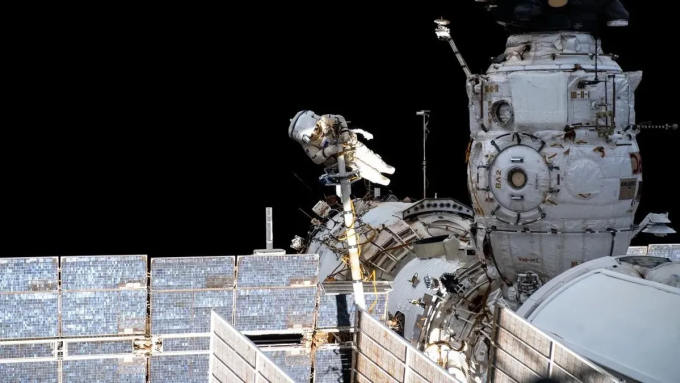
Roscosmos cosmonaut Pyotr Dubrov performs a spacewalk on the International Space Station (ISS) in June 2021. The Russian Zvezda module is visible below him. Photo: NASA.
Shelter orders are rare on the ISS, but space debris collision risks and fluctuations in air leak rates have triggered the protocol several times in recent years. Despite these incidents, astronauts have never been forced to fully evacuate the ISS due to an air leak in the station’s 25-year operational history.
Space reports that the ISS is scheduled to remain operational until 2030. However, a bill currently before the U.S. Congress aims to extend the station’s lifespan by an additional two years to provide more time for private companies to develop replacement stations.