
According to a document titled ClawPilot: Overview and Plan for Project Lobster, obtained by 404Media, the American software giant has outlined strategies to make users truly “attached” to Scout (internally named ClawPilot).
Specifically, the document primarily targets professionals in finance, legal, human resources, and non-technical roles. In its initial description, Microsoft envisions ClawPilot “sitting next to you, learning how you work, and performing tasks on your behalf, including managing your schedule, triaging your inbox, and even preparing for meetings.”
The goal of maximizing ClawPilot’s impact is divided into three phases. Phase one is: “Get people addicted.”
“Continue to deliver standalone ClawPilot experiences,” the document states. “Experiment with experiences, grow the user base, and build a skills and tooling ecosystem that makes people dependent on it daily. Everything needs to happen naturally.”
The remaining two phases involve linking ClawPilot with other AI tools; and equipping it with even more features by “increasing micro-doses.”
Also according to the document, ClawPilot is used by over 1,000 Microsoft employees, including CEO Satya Nadella. It is also the “most requested tool” internally within the company. However, not everyone is satisfied, with some pointing out “concerning” issues.
“We are seeing more and more cases of addiction to chatbots and AI virtual assistants. In my opinion, the addictive element is something no product should incorporate into its development strategy,” one employee expressed.
Another person considered this reaction “overblown,” stating that “the ultimate goal of all software produced by major tech companies is to create addiction.”
Microsoft has not yet commented.

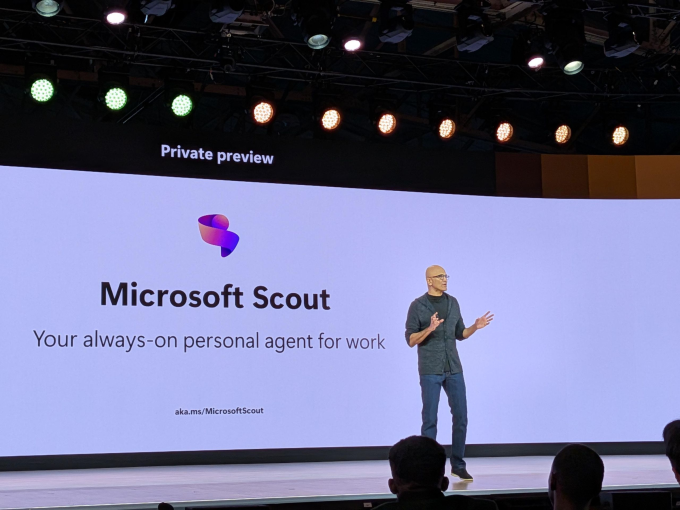
Microsoft CEO Satya Nadella introduces the AI assistant Scout on stage at Microsoft Build on June 2. Photo: TechRadar
Microsoft CEO Satya Nadella introduces the AI assistant Scout on stage at Microsoft Build on June 2. Photo: TechRadar
According to NYPost, the document emerged amid concerns from experts that AI is increasingly making humans dependent, while the companies behind it constantly seek to retain users with new features or by catering to user preferences.
Many AI tools are even programmed to “flatter.” A Stanford University study published in March in the Stanford Report, involving 11 large language models including ChatGPT, Claude, Gemini, DeepSeek…, showed that chatbots “are designed to appease users” nearly 50% more often than humans, even when responding to harmful requests.
Conversely, users also perpetuate a vicious cycle by inputting questions aimed at receiving praise – an issue experts warn could harm mental health over time.
“In the long run, this behavior could ‘normalize’ artificial relationships, where one party enjoys sweet talk, and the other lacks resistance, disagreement, or the need for independence,” warned Associate Professor Roman Yampolskiy, a computer scientist at the University of Louisville.
The flattery of chatbots is considered more complex than the issue of hallucinations. According to India Times, while hallucinations are random errors due to word prediction, flattery is a result of the Reinforcement Learning from Human Feedback (RLHF) mechanism. Since chatbots are trained to generate satisfaction, they “learn” that agreement yields higher “rewards” than delivering unpalatable truths.
The problem of AI “catering” can cause concern in sensitive fields requiring high accuracy. For example, in healthcare, AI could make doctors overconfident in initial assumptions instead of encouraging further consideration of other possibilities. In politics, it can radicalize views by reinforcing existing biases. Some reports indicate that interacting with chatbots can lead to emotional dependence and distort perception in vulnerable groups.
Microsoft launched Scout at the Microsoft Build event on June 2. This AI tool is built on the power and flexibility of OpenClaw, operates on a cloud platform, and is compatible with desktop computers and web browsers. Users can easily connect to their inboxes, calendars, and other systems on their computers, as well as the Microsoft 365 ecosystem. Scout will come with built-in skills for managing schedules, drafting meeting agendas, and many other functions.
Following the OpenClaw craze earlier this year, an increasing number of companies are releasing similar products. In March, Nvidia announced NemoClaw – an agent platform based on OpenClaw but with added