
Last month, UBTech uploaded a video on YouTube featuring the Walker C1 dancing alongside real people, showcasing its ability to maintain balance, execute precise movements, and coordinate rhythmically with humans. The robot later performed ballet to Tchaikovsky’s “Swan Lake” with a dancer, demonstrating a high level of realism.
In April, a video of Unitree Robotics’ G1 model went viral as it glided on an ice rink, using wheels, roller skates, and ice skates instead of feet, displaying remarkable balance capabilities.
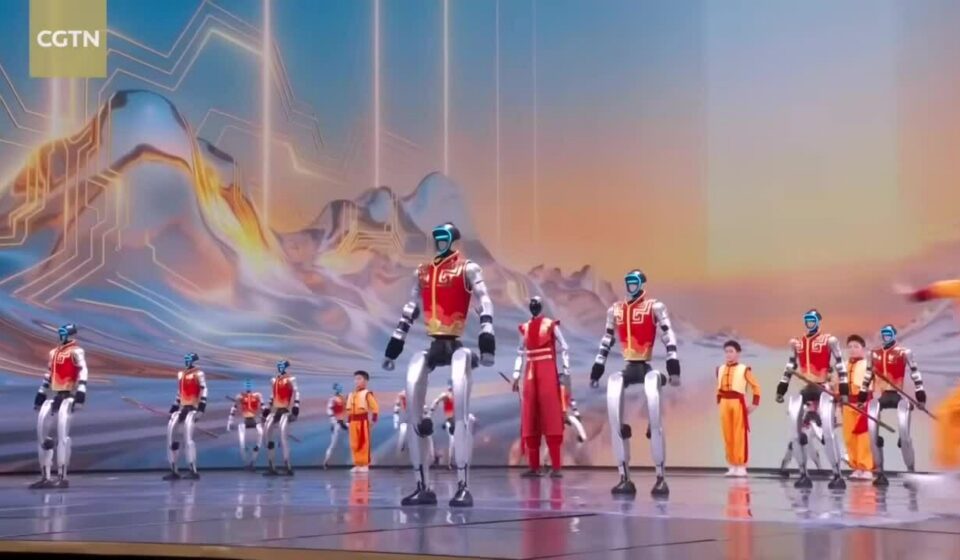
In addition to dancing and playing sports, Chinese humanoid robots have also impressed with stunning martial arts performances. During the Lunar New Year, a team of humanoid robots from four companies—Unitree Robotics, Galbot, Noetix, and MagicLab—joined forces with artists to deliver a spectacular show at CCTV’s Spring Festival Gala, the most-watched television program in China. According to CGTN, the robots not only performed martial arts moves but also wielded swords and nunchaku, showcasing speed, balance, and excellent coordination.

Humanoid robots performing at China’s Spring Festival Gala on February 16. Video: CGTN
However, according to Samm Sacks, a senior expert at the New America research organization specializing in Chinese technology, most of these performances are more demonstrative than practical, and they do not meet the demands of working in complex and unpredictable environments. Chibo Tang, an expert from Gobi Partners, which invests in tech startups, shares a similar view: “The applications of humanoid robots are still very limited.”
“Demonstration capabilities do not equate to reliability in industrial settings,” Georg Stieler, head of the robotics and automation department at global technology consulting firm Stieler Technology and Marketing, told the Guardian. He mentioned that what the robots achieved at the Spring Festival Gala was the result of training a process hundreds or thousands of times. “You can’t simply instruct them to change direction or do something entirely different,” he said.
According to China’s Ministry of Industry and Information Technology, last year, the country had more than 140 manufacturers and over 330 models of humanoid robots. However, the Chinese government has warned of the risk of a “humanoid robot bubble” due to slow commercialization and practical application.
“The economic factors are challenging because humanoid robots have high production costs, are prone to malfunction during operation, and require a tightly structured environment to function,” Sacks explained. She believes there is still a long way to go before people truly feel comfortable using them for elderly or child care at home.
She suggests that a more feasible path to commercialization might be through industrial and logistics sectors. However, this direction is also not straightforward as many factories are already equipped with robotic arms performing repetitive tasks, thus not requiring many humanoid robots.
Michael Tam, UBTech’s brand director, acknowledged that it is not easy to replace human labor with humanoid robots. He told the Financial Times that the company’s latest humanoid robot, the Walker S2, “achieves productivity equivalent to 30-50% of that of a human,” and is “only proficient in certain tasks” such as stacking boxes or quality checking components.

Robots handling packages in the Jiang Gao logistics area of the Guangzhou postal center. Photo: Xinhua
In Japan and the U.S., humanoid robot startups also face challenges in finding buyers in industrial sectors and other work environments. However, China still has some advantages in rolling out products into real-world applications.
First, according to AP, with its status as the “world’s workshop,” China leads in mass production capabilities, hardware supply, and data collection for training humanoid robots. According to a report by investment bank Barclays, Chinese humanoid robots are expected to capture up to 85% of the global market share by 2025. The technology research firm Omdia (UK) noted that over 13,000 humanoid robots were shipped globally last year, with the top two robot companies, Agibot and Unitree, each shipping over 5,000 robots. Competitors in the U.S. like Figure AI and Tesla produce only a few hundred robots or fewer.
As the production of humanoid robots increases, costs will decrease. The U.S. bank Morgan Stanley noted that greater use of domestic components also makes Chinese robots, on average, 20% cheaper than foreign robots. The bank estimates that the average price could drop to $21,000 by 2050, significantly lower than the $46,000 average last year. Some Chinese humanoid robots are even sold for under $6,000.
Many academic laboratories and businesses are also purchasing humanoid robots for research. According to Morgan Stanley, the total number of orders in China by 2025 is worth over 2 trillion yuan (295 million USD), with the majority coming from state-owned enterprises aimed at use in power plants, data centers, or entertainment.
Lian Jye Su, an expert at Omdia, predicts that as technology advances, humanoid robots may perform tedious and heavy tasks in warehouses, factories, and ports. Xinhua has reported that humanoid robots began operating this month in the Jiang Gao logistics area of the Guangzhou postal center. These machines undertake various tasks, including sorting and recognizing packages, with the ability to process up to 1,200 packages per hour.
Chinese robot companies are also striving to enhance the applicability of their products. The startup EngineAI in Shenzhen stated that aside from showcasing skills like dancing and boxing, their life-sized humanoid robots can also serve as security guards and museum guides. The basic version costs 180,000 yuan (26,600 USD). “The next step is to transition to more realistic scenarios,” Issac Li, head of marketing at EngineAI, told AP.

A humanoid robot from Unitree being trained for household tasks. Photo: Unitree Robotics
Ye Tian, a former Apple engineer and founder and CEO of the Chinese startup RoboScience, believes that people in the country have become relatively accustomed to rapid technological changes. Allan Zhang, founder of the startup Matrix Robotics, believes there is a “huge household market” where robots could perform household chores in hundreds of millions of families in the populous country.
In Beijing, content creator Yang Ning has tried out a cleaning service with a robot equipped with arms and hands. It can perform simple tasks like organizing shoes, folding clothes, and replacing trash bags, but still requires a human cleaning staff to accompany it. Although she commented that the support robot was not very effective and somewhat “too large and difficult to maneuver in a small house,” Yang shared that watching the robot arrange shoes at the door was “amazing.”
Thu Thao compiled the content.