
Canada is the latest country proposing to ban children under 16 from using social media, with some exceptions for platforms that meet safety standards. The bill also regulates the safety level of AI chatbots for young people through a digital regulatory agency specifically tasked with establishing standards.
Failure to comply could result in social media companies operating in Canada facing fines of 3% of global revenue or 7.2 million USD, whichever is greater. “The law will create a safer environment for youth, helping them connect directly, build friendships, focus on learning, and acquire practical skills for holistic development,” said Marc Miller, Canada’s Minister of Identity and Culture, on June 10 while announcing the bill.
The bill may take a year for Parliament to pass and 18 months to establish the digital regulatory agency. Google has stated it will commit to cooperating with the government, while Meta, X, and Snapchat have yet to comment.
Australia is one of the first countries in the world to implement a nationwide ban on children using social media. According to the legislation passed by its Parliament at the end of 2024, taking effect from December 10, 2025, individuals under 16 are prohibited from creating or maintaining accounts on platforms such as TikTok, Instagram, Facebook, Snapchat, or X. Instead of penalizing users or parents, the law places the responsibility on technology companies, requiring them to implement effective age verification measures, with potential fines reaching tens of millions of USD for violations.
Platforms have 12 months to make the necessary changes before compliance begins on December 10, 2025. However, during this time, many companies are attempting to lobby for a delay in the bill’s passage. Meta has described the law as “rushed and difficult to enforce,” Snapchat has warned of “unforeseen consequences,” and Reddit has even filed a lawsuit claiming the ban is “invalid.”
According to Reuters, one month after the law was enacted, social media companies collectively disabled nearly 5 million youth accounts in Australia.

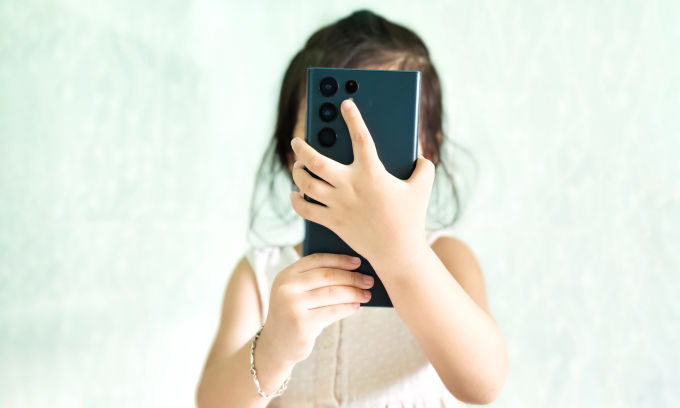
A child using a smartphone. Photo: Bao Lam
In March, Indonesia announced a ban on children under 16 from accessing social media due to concerns over risks such as pornography, online fraud, and internet addiction. According to Indonesia’s Minister of Communications, Meutya Hafid, accounts of children under 16 on high-risk platforms will be disabled, starting with YouTube, TikTok, Facebook, Instagram, Threads, X, Bigo Live, and Roblox.
Before the ban was announced, Hafid stated that the misuse of digital platforms could affect children’s mental health and development. She emphasized that the target of the regulation is technology companies, not children or parents. Platforms that fail to fulfill their obligations will face penalties.
With this latest measure, Indonesia becomes the first country in Southeast Asia to ban children under 16 from using social media.
Norway was one of the first countries to propose a social media ban for children under 16, even before Australia. However, in April, the government finally announced plans to present the bill to Parliament.
If passed, technology companies will be required to implement age verification mechanisms to prevent children from creating accounts. The Norwegian government believes that children increasingly face risks of online bullying, exposure to harmful content, and psychological pressure from social media algorithms. Although it has not yet officially become law, the proposal is considered the most stringent measure in Europe currently.
In April, Turkey proposed banning children under 15 from creating accounts on social media, requiring digital platforms to establish age verification systems.
The government argues that social media increases risks for minors, including online bullying, exposure to inappropriate content, and mental health issues. Turkey’s Ministry of Transport and Infrastructure stated that Australia’s model is one of the references used in developing its policy.
The law is expected to be officially signed by Turkish President Recep Tayyip Erdogan this month before coming into effect.
Malaysia is promoting several measures to protect children in the digital environment, including plans to restrict or ban those under 16 from using social media this year. Last year, the government indicated it was developing a legal framework requiring digital platforms to enhance age verification and take greater responsibility for protecting minor users due to concerns about children being exposed to harmful content, online scams, bullying, and mental health risks.
Malaysia has repeatedly stated that it is referencing management models from Australia and some European countries, but has not yet implemented them. If passed, Malaysia could become the second country in Southeast Asia to impose strict age limits on social media use.
In March, the Austrian government announced it would ban children under 14 from using social media and is preparing legislation to limit children’s access, including raising the minimum age to 15 or 16, while requiring technology platforms to adopt more effective age verification mechanisms.
Austrian officials believe that children increasingly face risks such as online bullying, exposure to harmful content, and negative impacts on mental health from social media. The bill is currently in the finalization stage and has not yet been passed by Parliament, but Austria is considered one of the European countries actively participating in the wave of tightening social media regulations for minors.
Other Countries
In addition to the trend of raising the minimum age or proposing bans on children using social media, many countries are opting for their own management models. China requires platforms to implement a “child mode” with time limits, content restrictions, and access hours. Children under 15 in France must have parental consent to create social media accounts, while the European Union is pushing for age verification measures and child protection within the framework of the Digital Services Act (DSA).
Numerous countries, including Poland, Portugal, Slovenia, Spain, Italy, Germany, the United States, and Greece, have no legislation yet but are beginning to consider control mechanisms to keep children safe. According to Straitstimes, this indicates that many governments are shifting from a voluntary approach to legal requirements, forcing technology companies to take greater responsibility for protecting young users in the online environment.
Bao Lam summarized