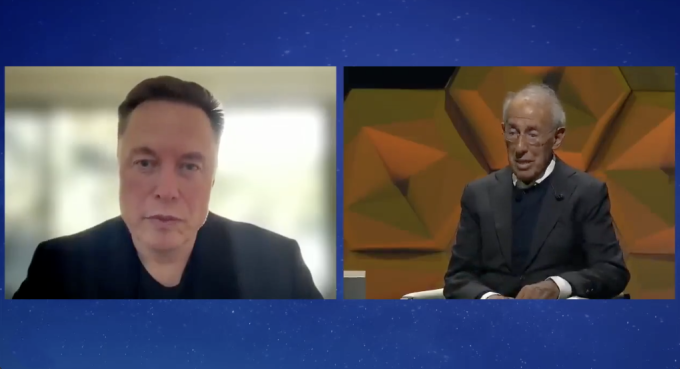

The information was mentioned by the billionaire during a conversation with Ron Baron, founder of Baron Capital, which aired on June 9. He stated that he could envision the entire physical chip design and the next-generation processor from Tesla outperforming Nvidia in reasoning capabilities “by a significant margin.”
Musk referenced the AI5 – a reasoning chip that Tesla completed designing in April. The American billionaire sees this chip as a key factor in expanding Tesla’s self-driving capabilities, asserting that the system is currently “four times safer than human drivers” and “will improve tenfold in the future.”
Musk also dismissed TSMC’s claim that building a new chip manufacturing plant would take five years. “To me, five years is an eternity,” he emphasized.

Elon Musk (left) chatting online with Ron Baron. Photo: X/Ron Baron
Production will take place at Terafab in Texas, a complex expected to produce advanced AI chip models for robotics and space data centers, aiming for a computing capacity of one terawatt per year, double the half terawatt capacity of the largest existing factory in the U.S. Musk even set an ambitious goal for this facility to produce one million wafers each month.
Intel’s Q1 2026 earnings report from April also showed the reason Musk wants them to participate in the joint venture. Intel’s Foundry manufacturing segment has grown to $5.42 billion, a 16% increase year-over-year, while the Intel 18A technology is currently being mass-produced in Arizona and Oregon. Musk indicated that Terafab will utilize Intel’s 14A process.
Meanwhile, Nvidia continues to dominate the AI chip market. The Vera Rubin platform, the successor to Blackwell, has been confirmed to reduce reasoning token costs by tenfold. According to AOL, this is a gap that is difficult to bridge, especially with a party that has yet to commence commercial operations like Terafab.
On social media, most expressed skepticism about Musk’s claims. He often sets ambitious goals with bold promises, some of which have materialized, but many objectives remain unachieved or are continuously delayed.
One of Musk’s successful commitments has been to promote electric vehicles as a mainstream product. When Tesla launched the Roadster in 2008, the electric vehicle market was virtually nonexistent, but now the company has become one of the largest electric car manufacturers in the world, contributing to the industry’s overall transition. In the space sector, Musk aims to drastically reduce rocket launch costs through reusability – a concept that was once doubted due to technical complexities, yet SpaceX now frequently reuses the first stages of Falcon 9 and Falcon Heavy.
However, in 2016, he announced that Tesla vehicles would achieve full self-driving capabilities within a few years. After ten years, this technology still requires driver supervision. He once stated he would send people to Mars in the 2020s, but he is facing numerous challenges regarding technology, safety, and regulations.
According to Bloomberg, looking back at history, most of Musk’s statements lie between the “borderline” of vision and optimism: often missing the set deadlines, but also realizing goals that were once deemed impossible, making each of his new commitments continuously attract attention from investors, the tech industry, and the public.
Bảo Lâm tổng hợp